Miraculous Printing of the Book of Mormon?
by John P. Pratt
Reprinted from Meridian Magazine (14 Apr 2005).
©2005 by John P. Pratt. All rights Reserved.
Index,
Home
Were miracles required to print the first edition of the Book of Mormon? This
article reviews evidence from an "old-time" printer who claims exactly that.
Latter-day saints have from their beginning believed that a series of miracles led to the coming
forth of the Book of Mormon. But among the many recorded miracles, including an angel
revealing where golden plates were buried and special interpreters being used so that they could be
translated by the gift and power of God, to my knowledge the actual printing of the first edition of
the Book of Mormon passed almost without comment among Church historians until recently. It
took an "old-time" printer turned L.D.S. Institute of Religion teacher named Gordon Weight to
notice that it may have been miraculous to print 5,000 copies of the Book of Mormon in only seven
months with the technology of that time. This article reviews and evaluates the evidence from his
booklet entitled Miracle on Palmyra's Main Street.[1]
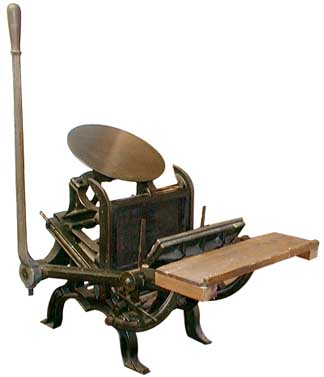 |
Press similar to John Pratt's.
Why is this article appearing in my Science and Religion column of Meridian Magazine? It seems appropriate for three reasons. First, it involves several calculations concerning the "science" of
printing, which require a technical review. Second, long ago I was an "old-time" printer myself,
and hence have some qualifications to critique his work.[2] And finally, I believe I can supply one missing piece of the puzzle, namely, just what was the approaching publication deadline which might have required angelic intervention to attain.
1. Historical Review
The seven months it took to print the Book of Mormon is well documented. The contract with E.
B. Grandin's print shop to print the book was signed on Tue 25 Aug 1829, and the completed book
was on sale by Fri 26 March 1830.[3] Should we suspect anything is unusual just by knowing that it took only seven months?
Seven months has seemed like plenty of time to print a book, so it is not surprising the almost
nothing more has been stated in official histories of the Church. For example, the Prophet Joseph
Smith's History of the Church passes over the printing in one phrase: "Whilst the Book of
Mormon was in the hands of the printer, we still continued to bear testimony . . ." (DHC I:74-75).
B. H. Robert's Comprehensive History of the Church doesn't elaborate much more on such a
mundane issue as taking a book to be printed. He does include excerpts from the account of the
typesetter John H. Gilbert that he did most of the punctuation of the book, notes that there was a
special second manuscript produced just for the printer, and includes the account of Esquire Cole
printing his own newspaper at nights and on Sunday at the same print shop. Cole was illegally
including "one form per week" of the Book of Mormon in his newspaper, peppering it with
vulgarity, so that his readers could read it without paying the Smith's for it.[4] The Prophet Joseph's mother's account includes this story in detail.[5] While none of these accounts addressed
anything special about the printing operation per se, they include some useful details, such as that
the printing of the Book of Mormon was not done at night, nor on Sundays, and that it was being
completed at a rate of at least "one form per week." We will consider below just what a "form"
was, and what technical information that gives us. Sister Smith notes that her son Hyrum
discovered that Cole had been publishing the excerpts for some 6 to 8 weeks before he was caught
and stopped.
If official church histories noted nothing unusual in the actual printing, why should anyone think
that yet another miracle might have been required to accomplish the task? It is here that we need the
expertise of an "old-time" printer to enumerate the difficulties that had to be surmounted.
 |
Can you read this word in handset type?
2. Estimate of Production Time
Gordon Weight was well qualified to make the calculations he did of just what it would take to
print the Book of Mormon in 1830. He was a compositor (typesetter) for the Deseret News newspaper in Salt Lake City, when it was still typeset by hand in the 1950's. Soon afterward that process would be replaced with the linotype machine which pours hot lead to form an entire line of type at a time, and which was set by an operator at a typewriter keyboard. When I worked in 1964 in a print shop, handset type had nearly all been replaced by the linotype machine. At that time I purchased all of
what remained of their handset type, cases and accessories for pennies on the dollar for my own
handpress business. Thus, I too have experience both in typesetting by hand as well as running
several hand presses. In his book, Gordon tells how they had contests to see who could set type
the fastest, because it was a critical skill needed to make press deadlines for breaking news stories.
Thus, he was used to timing himself and was very familiar with exactly how long it took the fastest
typesetters to set type.
2.1 Typesetting
Having set thousands of lines of type myself, I am a second witness to Mr. Weight's review of the
difficulty of setting type. First, the typesetter needs to be able to read letters set upside-down
because that his how the print looks in the hand held composition "stick" into which the type is set. But that is not much of a the problem because a compositor learns to read type upside-down almost as easily as normally.
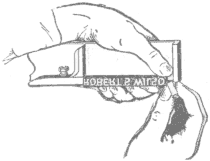 |
Typesetting in the Composing Stick.
The real problem is getting all of the lines to be the right
length. After a line of type is set in the composing stick, different size spaces must be inserted so
that all of the lines are "justified," that is, made to be exactly the same length. That can take as long as setting the entire line. It is necessary so that every piece of type is held in place by the side pressure exerted on it by the wooden blocks (called "furniture"). If a line is too short, it tends to fall out, and it if is too long, all the other lines fall out. Even in a flat bed press, loose type will tend to "work-up" and cause problems. Another tedious part of typesetting is that after use, it all has to be "broken down," that is, redistributed one letter at a time back into the two type cases. By the way, if you have ever wondered about why we call capital letters "uppercase" and small letters "lowercase" it is because the handset type was stored at that time in two cases, with the capitals in the upper case. In my day, it was all put into one case, but that single "California" case was not invented until the 1880's.
Weight points out that at his best typesetting rates, it would have taken all seven months of the
allotted Book of Mormon production time just to set and break down the type. That point alone
caused him to suspect that there may have been some "outside help" because there was only one
typesetter, and he could not work full time on typesetting because he was also one of the two
pressman for the first three months of work. That typesetter was John H. Gilbert, from whom the
23-year-old E. B. Grandin had bought the Wayne County Sentinel newspaper. Fortunately, Gilbert
prepared a statement for the L.D.S. exhibit at the 1893 World's Fair in Chicago of some of the
details of the printing, which is readily accessible on the internet.[6]
It is necessary to understand something about the printing process at the time to appreciate some of
the logistic details which caused Weight to conclude that miracles must have been occurring. After
the type was set for 16 pages, the 16-page "form" (now usually called a "signature") was locked
down and printed. Then that type was broken down and the next 16-page form was typeset.
Thus, typesetting could not be done continually for two reasons. First, the typesetter was also one
of the two pressmen, the other being J. H. Bortles. Secondly, Weight argues that he sees no way
that Grandin would have had enough type to have Gilbert be setting another 16-page form while
one form was being printed. That argument was based on the fact that Joseph Smith required "new type" in the contract, and that was not easy to come by quickly at that time. Thus, he argues that the press time must be added to the typesetting time because the two operations could not be done simultaneously.
2.2 Printing
The actual process of printing was painstakingly slow in 1830. The work was accomplished on a recently purchased Smith press, of which a near-perfect replica has been produced by Steve Pratt of Beaver, Utah (see illustration).[7] The printing was done with all 16-pages printed with one impression on one side of a piece of paper about 18 x 30 inches in size. Then those same 16 pages were printed on the other side in such as way that opposite pages were in the correct places, and then paper then cut in half so that each sheet made two 16-page signatures. Thus, the 5,000 impressions required 2,500 sheets of paper for each of the 37 signatures needed. That's a lot of paper, which would have made six stacks about five feet
high.[8]
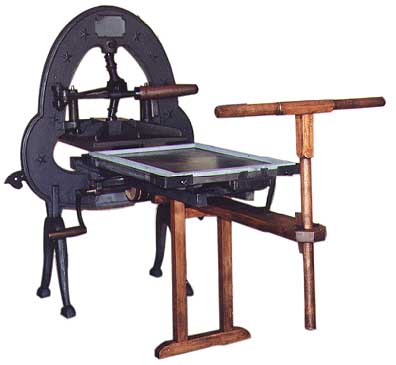 |
Replica of the press used to print the Book of Mormon.
The printing process required that the type be inked by hand with a leather ball filled with sand. That fact shocked me. Why didn't they use a rubber ink roller like I did, which would have been so much faster? Because Charles Goodyear didn't learn how to vulcanize rubber until 1843! It was a very different world in 1830. After a sheet of paper was placed on the inked type, the bed with the type and paper was cranked over under the platen, and the lever was pulled to print the form. Then the bed was cranked out, and the sheet removed from the type and laid out to dry. Before you read Weight's estimate of how long this would take, look at the illustration and estimate for yourself how many seconds you would allow for each step of this process.
This process was repeated 5,000 times for each of the 37 signatures. Weight estimated that it would have taken an hour to make 100 impressions. That is 36 seconds per impression for the entire printing cycle! How does that compare to your estimate? At that rate it would require nearly three days (25 hours) to do the 2,500 impressions on one side of a piece of paper. He equates that with Gilbert's statement that it took "nearly three days to print each form." If so, then it would require 50 hours for each of 37 signatures, which Weight
estimates to have taken some 8.5 months for the printing alone. Considering that Weight believed
that the printing could not be done simultaneously with the typesetting, that would require 15.5
months for the two jobs together. But that does not include the binding time.
2.3 Binding
The laborious job of binding the 5,000 books by hand required that all of the signatures be
completed before the final binding of the first book could begin. As each signature was completed
the sheets were cut in half, then folded three times and clamped in a device which Grandin
invented, called the Grandin Clamp. That part of the work could keep up with the press work.
But only after the last signature was completed could the signatures be sewn together by hand
through the back of each signature. Then the books were removed from the clamp and trimmed to
size with a hand paper cutter. Then the leather-wrapped cardboard covers were attached. Weight
estimates that two months would be required to bind the copies of the Book of Mormon after
all the press work was completed. Thus his total estimate of the time that should have been
required to produce the first edition of the Book of Mormon was 17.5 months. But it was
completed in almost exactly 7 months. Thus, he concludes that some sort of miraculous
intervention must have occurred, but doesn't speculate on just what it might have been.
2.4 Unusual Events
Weight asks several other questions and implies that the lack of good answers also points to
miraculous events. To me they clearly point the way where future research is needed before any
compelling evidence for miracles can be drawn. These questions include:
Why did E.B. Grandin change his mind about printing the book, after having originally refused to
have anything to do with Joseph Smith's "Gold Bible"? Weight hints that Angel Moroni might
have visited him to assure him all would be well. He does not speculate that any supernatural source might have given Grandin the idea for the binding clamp he invented.
Where did the large amount of new type come from to print the book, as required in the contract? Historians have suggested Albany, but Weight claims there were no local foundries and that all type at the time came from Germany or China. Weight estimates that it would have weighed at least 760 pounds just to be able to set 16 pages at a time.
Where did the paper come from? At the request of Joseph Smith, the contract also called for thin white paper, opaque enough not to see the print on the other side of the page. Weight claims that the process for producing such paper used had not been developed by that time and that most books were printed either on one side of the page, or on thick paper. Moreover, the paper was apparently all delivered mysteriously one night.[9] Why would Grandin agree to such an unreasonable request? And who paid for all this new type and special paper, seeing as Martin Harris had not yet sold his farm to make any payment at all for materials?
Why wasn't the work stopped by mobs destroying the press as with other publications of sacred
works of the restoration? Here Weight offers folklore accounts of attempts to do so which were
thwarted by miraculous methods, which also need more research to verify. They included an
account that when the mob tried to disassemble the press they found it one solid piece held together
by "angel glue." When they further tried to push the press through the wall out onto the street from
the third floor of the building, the building was said to "groan" so much, apparently on the verge
of collapse, that the mob left in a panic. Those are great stories, but much more verification is
needed.
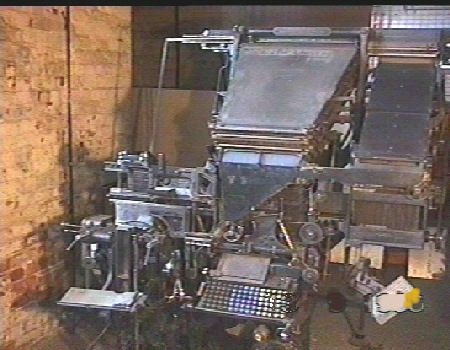 |
The linotype machine which replaced handset type.
3. My Commentary
Weight leaves the reader with the definite conclusion that some sort of divine intervention was
required to get the Book of Mormon printed in a mere seven months. He does not provide any
specifics on just how those miracles were accomplished. He convinced me that something out of
the ordinary was going on, but I cannot leave the subject without some attempt to explain what really happened. So here is my attempt at an explanation, which is calculation mixed with speculation.
3.1 Economy of Miracles
Before I begin, I must state my own personal prejudice, which could even be dignified by being
called a theory of miracles. I call it the "Economy of Miracles" or "Economy of Revelation"
principle. It is that the Lord will always provide the minimum miracle or revelation that will fulfill his purpose. In this case, for example, he won't employ angels to do typesetting and presswork at
night, which would surely be discovered, if the same result could be accomplished by hiring
another pressman or getting some more type. This is especially true when he is trying to remain
low-profile and not have the miracles noticed. The exception to my proposed rule may be the
cases when he wants to be high-profile and let people know with certainty that his arm has not
been shortened, in which case he might use a cloud by day and a pillar of fire by night. But even
that seems to me to be the smallest miracle to get the job done as he wishes. This principle also ties
in with Ron Millett's "Fair Test" principle in last month's article that the Lord cannot make it so obvious that his work is true that people would not have a fair test of their faith.[10] So we cannot expect Angel Moroni to come down in a pillar of light to deliver the type nor the paper. The Lord finds much more subtle ways to get "mini-miracles" accomplished, which often go entirely unnoticed.
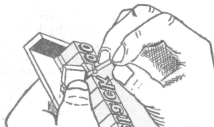 |
Justifying a line was tedious.
3.2 Typesetting
With that in mind, let us consider each of Weight's estimates in the light of knowing the answer in
advance: the work indeed was completed in seven months. I must agree with Weight that is hard
to imagine setting, proofing, justifying, and making ready a page of the Book of Mormon in less
than two hours. It would have taken me much longer than that. That implies 4 months of 60-hour
weeks (six 10-hour days), which is about what I think it actually took. As for redistributing the
type after setting, I think his estimate of 2.5 months is too high. I could break down the type in about a quarter of the setting time because it could just be dropped quickly into the compartments, rather than having to set it carefully in position, and there is no time required for proofing or justifying. Thus, my estimate would be only about one more month needed for redistribution, for a total of five months of
typesetting operations.
In the "Folklore" section of his booklet, Weight notes that John Gilbert's sister reportedly claimed
that
"on several occasions, he [John Gilbert] would go into the shop in the morning
expecting to have to redistribute the type from the previous night's press run in
order to start setting type for the next pages. However, when he arrived, he found
the type had already been redistributed back into the type case, and further that
every piece of type was neatly standing on its feet, face up, rather than being
randomly scattered in its individual compartment." [11]
That is a very interesting claim, which needs more research to substantiate whether or not such a
letter still exists. It definitely fits my economy of miracles theory that if angelic intervention was
necessary, it would be in breaking down the type rather than setting it.
The principal place where I believe that Weight made a faulty assumption is in the amount of type
that was available. He argues that there could only have been enough type to set one 16-page signature,
and concludes that even getting that much type would have required a minor miracle. Well, if a
miracle is required, then let's be aggressive and assume that enough type was obtained to set 32
pages at once, so that Gilbert could be setting the next signature while one was being printed. To
me this conclusion is almost forced for two reasons. First, the book was indeed completed in
only seven months, so somehow the work had to be done faster, and this seems like the easiest
way to explain it. Second, another pressman, Thomas McAuley, was hired in December, at which
time Gilbert was freed up to spend full time on typesetting. If there had not been sufficient type to keep Gilbert busy, then the second pressman would not have been needed. A simple thing
like twice as much type would allow the compositor to work in parallel with the two pressmen, preparing the next form for them to print. Simply having the amount of type necessary to do the job falls neatly into the Economy of Miracles idea. That is, it might have taken a miracle, but it would have been so small as to have gone unnoticed all this time.
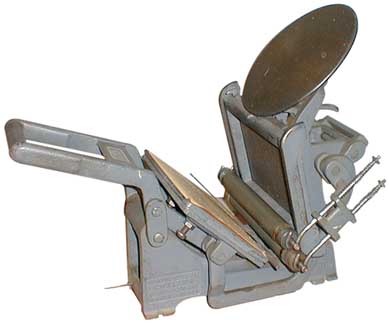 |
A Kelsey "Excelsior" Press, was owned by the author.
3.3 Presswork
I mostly agree with Weight's estimates of the amount of time it would take to print each
page. When I had my own hand press, which could print one 5 x 8 page at a time, it
was a much faster operation where one hand could pull the ink rollers across the type while the
other hand simultaneously fed the paper. The press on which the Book of Mormon was
printed clearly required two men to operate efficiently, with each doing one of those functions.
One would ink the type and pull the printing lever while the other would put the paper in place on
the type, and then lift it off to dry somewhere. How long would that take?
I estimated charges for my own press work at 600 copies per hour, but I only actually attained that
speed when everything when well. Weight estimates 100 impressions per hour for the Book of
Mormon. The inking for each page was not done by automatic rollers, or even by a hand roller,
but with a ball, which required at least 7 seconds for each impression. Turning the handle to crank the type into position would have required at least 5 seconds each way, the printing level could be pulled in 3 seconds, and the paper put in position and removed in 2 seconds each. So my estimate is 24 seconds each, or 150 per hour. But this estimate is really optimistic and Weight's estimate of 36 seconds each seems more reasonable. I'm just trying to calculate what it would take to get the job done in the time it actually took. Look again at the earlier illustration of the replica of the press used and ask yourself if you would accept the job of pressman if you knew that was the printing speed expected.
Gilbert says it took 3 days per "form" and it is clear that he meant both sides of the signature, not
just one side as Weight assumes. Gilbert is reporting on what actually happened and Weight is
estimating what he believes the fastest rate possible in 10-hour days would have been. Three days
for each of 37 forms is 111 days, which is less than four months of total printing, not 8.5 months that
appeared more reasonable to Weight. My estimate of 150 per hour means it would take 33 hours
to complete one form. Redistribution time does not have to be added because the other pressman could have done that while the press was idle. That is three 11-hour days, which was not an uncommon work-day at that time. Thus, a printing rate of 150 per hour and 11-hour days agrees with Gilbert's recollection of 3 days per form and a total printing time of under four months. That does not require a night shift of printing, which fits with the Esquire Cole story that he was using the press at night.
Here is my proposed scenario. At first there were only two men, so the typesetting could not be
done at the same time as the printing. During those first three months, the typesetting of one form
required 32 hours (Weight's estimate) and the printing 33 hours (my estimate). That is 65
hours, which is one 6-day week of about 11 hours each. That rate of one form per week is exactly
what Squire Cole had promised his readers, so that fits well. Thus, the work proceeded at one
form per week for three months, so that 13 forms were completed by that time. Then a second
pressman began, which doubled the production rate because now the 32 hours of typesetting time
could be done simultaneously with the 33 hours printing time of the previous form.[12] That means
that thereafter, two forms could be completed in a 66-hour week. That would require another
twelve weeks for the last 24 forms, to complete the 37 required. Thus the entire printing could
have been done in six months given that there was enough type to set 32 pages concurrently. That
would leave one month to bind enough books to begin sales. Do we know that all 5,000 books were bound before the first ones went on sale?
So were any miracles required? I believe that several of the questions that Weight raised may turn
out to require miracles. And just how small can a miracle be to qualify as a miracle? Was the
arrival of the second pressman a miracle? He arrived just in time to double the production rate to
barely finish the job "on time". I don't have those answers, so let us turn to the question of just
what was the publication deadline, which was so important that angelic intervention might
have been required to meet.
4. Book of Mormon "Resurrection" Date
One point which eluded Weight was knowing just what was the great importance of having the
Book of Mormon finished in March, 1830? Who set that publication deadline, which was so
important that extraordinary efforts were required to get the job done on time? After all, the Prophet Joseph Smith had had the plates since the fall of 1827, and Satanic forces were allowed to delay the work for a year and a half until it began in earnest with the arrival of Oliver Cowdery on Sun 5 Apr
1829. Much has been written about the miracle of translation of the book in only three months of
concentrated work, with the manuscript being done by August. Combining that amazing speed of
translation with the unusually high speed of printing suggests there was some sort of big
deadline involved. What was that deadline?
Weight concludes that it must have been that the Book of Mormon was needed for the Church to be
founded, and implies that the founding date of Tue 6 Apr 1830 must have been the important
deadline. But he mostly raises the question with his section entitled "Why the Rush?" which he
really leaves unanswered.
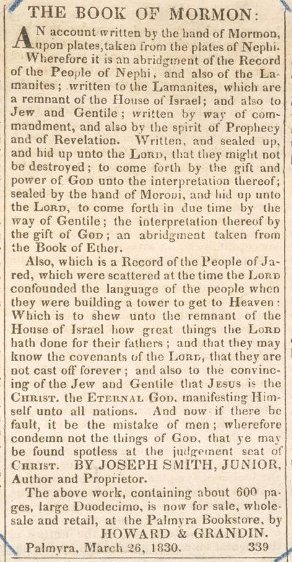 |
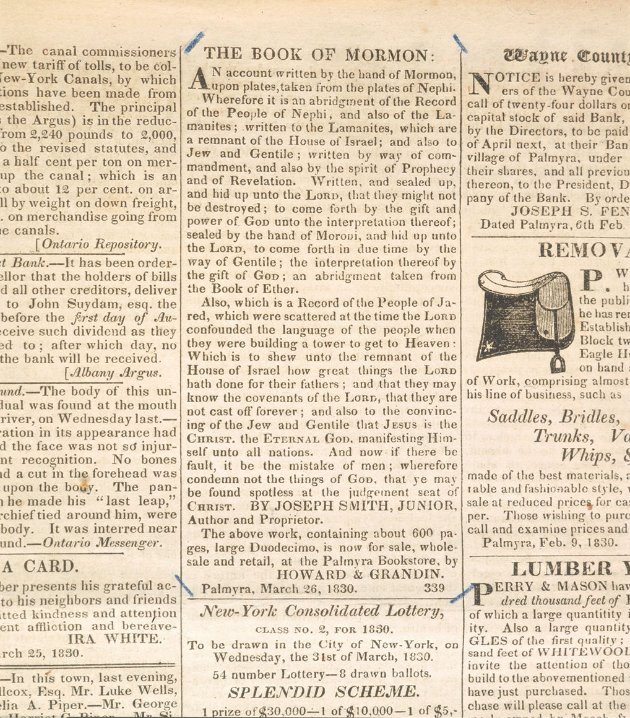
Book of Mormon announced for sale on 26 Mar 1830.
(Click to Enlarge)
I believe my research has already supplied the answer to this question. There was a deadline
carved into the Lord's sacred calendars for the Book of Mormon to be published. At my current
level of understanding, that date is much more important than the date of the founding of the
Church, which I believe was chosen mostly to reveal to us what the Savior's birth date had been.
In other words, the date of the founding of the Church on Tue 6 Apr 1830, was not a huge date on
sacred calendars to the best of my current knowledge. I believe it was chosen as a commemoration
of the Savior's birth on the evening prior to Thu 6 Apr 1 B.C.[13] That provides the symbolism
that the birthday celebration of the Church corresponds to the celebration day of the Savior's birth.
That is all well and good, but was it absolutely necesssary to have the Book of Mormon completed
before the Church was officially organized? If not, then just what was the mysterious deadline for
the Book of Mormon which may have been worthy of divine intervention to achieve?
My answer is it was the "Resurrection Date" of the Book of Mormon. This subject has been
treated elsewhere in depth and requires some knowledge of three proposed sacred calendars to
appreciate. Those are the Hebrew calendar, the Venus calendar and the Mercury calendar.[14]
Suffice it here to state only that to me there is compelling evidence that the Savior's resurrection
occurred before sunrise on the morning of Sun 3 Apr AD 33. That day was Easter on the Hebrew
calendar (the Offering of the Firstfruits of Barley), it was 1 Resurrection on the Venus calendar
(when the planet Venus also "resurrects"), and it was 1 Creation on the Mercury calendar (the
beginning of the cycle). The Savior's resurrection day was also sacred on several other calendars,
but it is only these three that are needed here.[15]
The day Thu 25 Mar 1830 was also 1 Resurrection on the Venus calendar, and also 1 Creation on
the Mercury calendar. Thus, on both calendars it was on exactly the same day as the Resurrection
of Jesus Christ, hence a perfect day to represent the coming forth of the Book of Mormon from the
earth. The Book of Mormon is a Native American book, and it seems totally appropriate for its
resurrection to be a red-letter day on those two Native American calendars. Moreover, it was also a
sacred day on the Hebrew calendar, being New Year's Day. That triple alignment is so rare that
only once in about five hundred years on the average do those two dates on the Venus and Mercury
calendars align with any of the ten principal holy days on the Hebrew calendar. Moreover, even
the Hebrew holy day adds meaning to the symbolism, namely that the day represented the
beginning of a new era for the restored Church. I have not been able to find any date in Church
history, with the possible exception of the proposed date of the first vision, Sun 26 Mar 1820,[16]
which is more important that the coming forth of the Book of Mormon from the dust. The next
day, Fri 26 Mar 1830 the Wayne County Sentinel announced that the book was already on sale, and to me
it is clear that is was precisely the previous day on which the volume officially went on sale.
While knowing the importance of that date explains just what the deadline was, still there are many
questions which Weight has raised which also demand answers, such as whether or not miracles
were required to produce the type and paper. We can do much more research to discover those
answers, but many final explanations may have to await a future date when all things will be
revealed (D&C 101:32-34).
5. Conclusion
Gordon Weight's book, Miracle on Palmyra's Main Street indeed raises several questions about
the technical details of just how the Book of Mormon could have been printed in a mere seven
months with the equipment of that day. He claims that many miracles were required but that they
could have been done with so little fanfare that they have gone unnoticed until now. His work
makes no attempt to explain how they were accomplished, but it definitely is an implied call for
more research in this area. Clearly, the first indications are that something extraordinary may
indeed have been involved, which is not surprising in a work that which already claimed to have an
angel, and even the Lord himself, guiding every step of the way. The day will come when we
shall learn just how many miracles were actually required to bring forth this amazing volume of
scripture.
Notes
- Weight, Gordon L., Miracle on Palmyra's Main Street, (Murray, Utah, 2003). It is available at 4649 S. 345 East, Murray, UT 84107, 801-262-9290.
- I worked for Printers, Inc., in Salt Lake City in 1964, at which time they were ready to dispose of all of their old-fashioned hand-set type. I bought all of it from them to augment my own printing company's fonts. I had three hand presses, used mostly to print business cards, wedding
invitations, labels, and other small jobs on my 5" x 8" press. I also had all needed accessories
such as furniture, leads, a lead cutter, and a large cabinet to hold the cases of type.
- Conkling, J. Christopher, A Joseph Smith Chronology (Salt Lake City: Deseret Book, 1979), p. 12 and p. 14.
- Roberts, B. H., A Comprehensive History of the Church of Jesus Christ of Latter-day Saints, (Provo, Utah: L.D.S. Church, 1965), pp. 157-162.
- Smith, Lucy Mack, History of Joseph Smith (Salt Lake City: Bookcraft, 1958), pp. 164-167.
- Gilbert, John H., "Recollections of John H. Gilbert" (Palmyra, N.Y.: 8 Sep 1892).
Transcript at www.boap.org/LDS/Early-Saints/JHGilbert.html.
- Smith press from the Briar Press Museum at www.briarpress.org/briarpress, then select "Museum" and then "Iron Press Examples."
- The first edition had 37 signatures of 16 pages each, or 592 pages. There were two pages left blank at the end, making 590 numbered pages, which is mistakenly transcribed as 570 pages in Gilbert's statement (see fn. 6). Weight notes that several LDS histories have spoken of signatures of 32 pages each, with 16 on each side of a single large sheet of paper. He point out that even though it was printed with 16 pages per side, they were really only 16-page signatures, as Gilbert explained in his statement. The height of the paper is estimated at 2 inches per ream (of 500 sheets), which is 10 inches per signature, or 370 inches in all. That makes a stack about 30 feet high, which Weight somehow overestimated to be 110 feet high.
- Weight, Miracle, p. 31 in his "Folklore" section: "Early on a September evening, after dark, there was a loud commotion behind the the Grandin Print Shop building. Accordingly, the constable was contacted to investigate. He stated that as he rode up the street he could hear men and wagons. When he bridled the horse and ran to the back of the building, he found no one there. All was quiet and everything in order — except for the large pile of paper neatly stacked on the back porch and numerous recent footprints and wagon wheel ruts found in the dirt."
- Pratt, John P. & Millett, Ron,
"Petrified Wood: Days or Millions of Years?," Meridian Magazine (16 Mar 2005), Section 1.3.
- Weight, Miracle, pp. 31-32.
- Here I have omitted the type redistribution time, which probably needs to be included. It is after the arrival of the second pressman that the compositor could have used some help in breaking down the type in order to keep up with the press. If his sister's letter about the type having been mysteriously redistributed at night is ever found, it would most likely refer to the time after the third man was hired in December.
- Pratt, John P., "Passover: Was it Symbolic of His Coming?" The Ensign 24, 1 (Jan, 1994), pp 38-45.
- Pratt, John P., " "Venus Resurrects This Easter Sunday," Meridian Magazine (27 Feb 2001), and A Native American Easter: How the Ancient American Calendar Testifies of Christ,"
Meridian Magazine (28 Mar 2001).
- Pratt, John P., "Religious Chronology Summary" lists these and all of my published sacred dates, along with the references where they are discussed.
- Pratt, John P., "Enoch Calendar: Another Witness of the Restoration," Meridian Magazine (5 Aug 2002), Section 1.1.