
Reprinted from Meridian Magazine (27 Aug 2002)
©2002 by John P. Pratt. All rights Reserved.
| 1. The Feast of Trumpets |
| 1.1 What is a Trump? |
| 1.2 A Voice of Warning |
| 1.3 This Year's Feast |
| 2. The Seven Angels |
| 2.1 Who are the Seven? |
| 2.1.1 Uriel |
| 2.1.2 Raguel |
| 2.1.3 Sariel |
| 2.1.4 Raphael |
| 2.1.5 Phanuel |
| 2.1.6 Gabriel |
| 2.1.7 Michael |
| 2.2 The Seven Rewards |
| 2.2.1 Tree of Life |
| 2.2.2 Conquer 2nd Death |
| 2.2.3 White Stone |
| 2.2.4 Commands Nations |
| 2.2.5 Clothed in White |
| 2.2.6 New Jerusalem |
| 2.2.7 Enthroned |
| 2.2.8 Pattern Witness |
| Table 1 |
| Notes |
The previous two articles in this series discussed a proposed model for the calendar described in the Book of Enoch[1] and noted that several key dates during the restoration of the Church of Jesus Christ of Latter-day Saints fell on symbolic holy days on that calendar.[2] Those synchronisms provide support for the Book of Enoch's claim that the angel Uriel revealed that calendar to Enoch, and that the Lord is actually still using it. It was also noted that this year is indicated on that calendar as the year of the Millennial Feast of Trumpets. Because this is the month of that feast, let us first review its symbolism, and then see what can be deduced about the seven angels who are symbolized sounding the trump.
|
The calendrical significance of the Feast of Trumpets is somewhat confusing because in a way it symbolizes both the first and the last. For many purposes the year begins in the spring and my writings refer to New Year's Day as 1 Nisan (Hebrew) or 1 Spring (Enoch). But for reckoning the 7-year sabbatical cycle the year begins in the fall on 1 Tishri (Hebrew) or 1 Autumn (Enoch). Modern Hebrews use 1 Tishri as the official New Year's Day for the civil year, calling it Rosh Hashanah, "head of the year." Months are reckoned from the spring which leads to the counterintuitive result that the modern Hebrew New Year begins on the first day of the seventh month (1 Tishri). Thus, the Feast of Trumpets is also celebrated as a New Year's Day.
 |
Is there any difference between a trump and a trumpet? Modern dictionaries say that "trump" is merely a poetic form for "trumpet." But the Lord is very consistent throughout the D&C to use the word "trump" when referring to what the angels sound, so perhaps that means that "trump" refers to the long straight instrument shown atop our temples, as opposed to the trumpet, which is the familiar smaller instrument with the tube coiled for compactness.
The kind of trumpet used seems less important to the Feast of Trumpets than the type of blasts which are sounded. What is the prescribed manner to celebrate the Feast of Trumpets? The Bible says precious little about what to do on that day:
In the seventh month, in the first day of the month, shall ye have a sabbath, a memorial of blowing of trumpets, an holy convocation.That is about all we are told, except that certain sacrifices are specified (Num. 29:1-5). Thus, this verse has led to two different names for the feast: the Feast of Trumpets and the Day of Remembrance.
Ye shall do no servile work therein, but ye shall offer an offering made by fire unto the Lord. -- Lev. 23:24-25
So how do the Hebrews celebrate the day? Basically in two ways. First, as New Year's Day, as discussed above. Secondly, because the scripture says to remember the blowing of trumpets, they review the many times in the Old Testament that trumpets are blown. Let us do likewise to understand the symbolism of the trump.
 |
The Jewish tradition is that God judges everyone annually at the Feast of Trumpets. Each person then has ten days to repent of any wrongdoing, for the judgment won't be sealed until the Day of Atonement on 10 Tishri. This is in keeping with the trump being both a warning sound, as well as heralding the Day of Judgment. This interpretation of the trumpet associated with Judgment Day is also found in the Book of Mormon:
. . . all men shall be awakened by the power of God when the trump shall sound; and they shall come forth, both small and great, and all shall stand before his bar, being redeemed and loosed from this eternal band of death, which death is a temporal death. -- Mormon 9:13
Searching the internet for "shofar" yields many sites which explain that the announcement of Judgment Day is the usual interpretation of the trumpets sounded on Rosh Hashanah. One excellent summarizing title is "The Shofar: A Wake Up Call." It is a time for all of us to awaken to the seriousness of our current situation and to return to God, as individuals and nations. Other soundings of the trump which are often commemorated at the feast are the trump heard at Mt. Sinai, the day on which Adam and Eve were judged, and the creation of the world.
A similar title was chosen to summarize the idea by the apostle Parley P. Pratt. He entitled his pamphlet A Voice of Warning (quoting D&C 1:4), which showed on the cover an angel giving a blast on the trump along with the scripture:
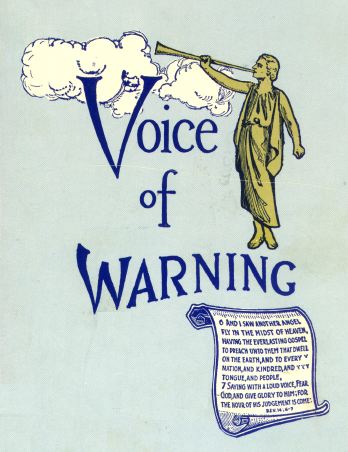 |
And I saw another angel fly in the midst of heaven, having the everlasting gospel to preach unto them that dwell on the earth, and to every nation, and kindred, and tongue and people,
Saying with a loud voice, Fear God, and give glory to him; for the hour of his judgment is come: and worship him that made heaven, and earth, and the sea, and the fountains of waters. -- Rev. 14:6-7
Note that the angel has the gospel to preach, even as the angel Moroni atop temples is sometimes depicted holding the plates, but what he is heralding with the trump is that "the hour of his judgment is come." The purpose of spreading the restored gospel is not just to fill in some details of which have been lost, but to warn of imminent judgments and to call upon all to fear and worship God. Note the Lord's consistent usage of this symbolism of the trump:
To lift up your voice as with the sound of a trump, both long and loud, and cry repentance unto a crooked and perverse generation, preparing the way of the Lord for his second coming. -- D&C 34:6
. . .the trump of God shall sound both long and loud, and shall say to the sleeping nations: Ye saints arise and live; ye sinners stay and sleep until I shall call again. . .
For in mine own due time will I come upon the earth in judgment, and my people shall be redeemed and shall reign with me on earth.
For the great Millennium, of which I have spoken by the mouth of my servants, shall come. -- D&C 43:18, 29-30
And in all his journeyings let him lift up his voice as with the sound of a trump, and warn the inhabitants of the earth to flee the wrath to come. -- D&C 124:106
Note of 3 Jun 2019: Several years after this feast was very successfully held, it was discovered that whereas my calculation was correct that New Year's Day of the year FEAST OF TRUMPETS (1 AUTUMN, Enoch) occurred in the spring of 2002, the named years begin in the fall of the preceding year. Thus, the year FEAST OF TRUMPETS (Enoch) began in Sep 2001, shortly after the attack on the Twin Towers! It now appears that the attack was the official wakeup BLAST of the trump to the world that the end times had begun. In retrospect, it was fortunate that the correct start date was not then known to me, or the feast would likely have been cancelled!
The Feast of Trumpets is associated with the sounding of the trump to warn the world of the coming judgments of God. As pointed out in the last article, this year appears to be an important celebration of the Feast of Trumpets on the Enoch calendar because the feast day Sun 22 Sep 2002 is the day 1 Autumn in the year 1 AUTUMN, which only occurs once every 364 years. Moreover, because the symbolism is to herald the coming judgments before the Millennium, this year appears to be the most important one in history on the Enoch Calendar. Accordingly, I will be holding a Millenial Feast of Trumpets to celebrate on Fri 20 Sep 2002 in Orem, Utah. For those wishing to have a family celebration, a link is provided to a suggested program which combines both the traditional Hebrew as well as my own latter-day enhancements.[4]
In both the Book of Revelation and Doctrine and Covenants, we are told that each of the seven angels has a trump, and each will announce different aspects of what is coming. Anciently the Feast of Trumpets included seven priests who each sounded the trumpet, which seems clearly symbolic of these angels. Let us now focus on who those seven angels are, and what is the message and the responsibility of each.
The Lord has given us many clues to identify just who the seven holy angels are, and at least some information about their duties. The biggest clues are in D&C 88:92-112 where we are told just what each of the seven angels says at the sound of his trump. That section is a summary of much of the Book of Revelation (Rev. 8-20), but it focuses on the triumphs of the saints, rather than the woes and judgments which will befall the wicked. Nevertheless, it makes it clear that the reason that the Lord revealed these details about coming judgments is that "it becometh every man who hath been warned to warn his neighbor" (D&C 88:81).
The first four angels to sound the trump each herald the resurrection of one of the four spiritual divisions of mankind. The first trump is for those who inherit the celestial kingdom, the second for terrestrial, the third for telestial and the fourth for the sons of perdition (D&C 88:98-102). The fifth angel to sound is he who is sent with the gospel to everyone (in all four groups), for "every knee shall bow" (D&C 88:103-104). The last two angels announce the final triumphs over evil, and while we are given few clues to their identity from their sayings, we are just told outright that the seventh angel is Michael, who is Adam (D&C 88:105-106,112).
So who are the first six angels? Each of the first four angels is apparently assigned to the group who comes forth at the sound of his trump. That is, each may well be the presiding elder over the celestial, terrestrial, telestial, and sons of perdition, respectively. Another clue is that each angel is assigned to a 1,000-year period of the earth's history, with the first angel presiding over the first 1,000 years, and so on until the seventh (Adam) presides over the Millennium (D&C 88: 108-112). We are also given the pattern of the seven presidents of the seven quorums of seventy, where it is the seventh president who presides over the other six (D&C 107:94), even as Michael (Adam) presides over the seven angels. Let us now attempt to identify each angel.
Who worked in mortality with those preparing to inherit the Celestial Kingdom, which is for those who are valiant in the testimony of Jesus Christ and who overcome all things? To whom did Jesus Christ commit the "keys of the kingdom of heaven?" (Mat. 16:19). To whom did the Lord refer as still possessing the keys of the kingdom of heaven even after he had visited the Prophet Joseph Smith and, with his counselors, ordained him to be an apostle? (D&C 27:12-13; 128:20) It is Peter.
Peter is the clear choice to be the angel who presides over those preparing for the celestial kingdom. Of course, each President of the Church holds the keys of the kingdom on earth with the authority to preside and to seal in heaven, but Peter could still preside over all celestial kingdom candidates, whether on earth or in the spirit world.
If Peter is the first angel, who presided over the first 1,000 years of history, then it would explain some apocryphal scriptures which state that Peter visited Adam to give him instructions.[5] In light of this identification, that would make sense on two counts: first, Peter would have been presiding over that millennium and secondly, he would be the file leader for Adam, who was certainly a celestial kingdom candidate.
Which name of the seven angels would correspond to Peter? In the chapter where Enoch lists their names, Uriel comes first (Enoch 20:2). If Uriel is Peter, then Uriel would have presided over the first thousand years, because they preside in the same order in which they sound the trump. In fact, it was Uriel who revealed the constellations (Enoch 32-35) and Enoch calendar (Enoch 71-78) to that prophet, who lived during the first thousand years. Why Uriel? Perhaps because it was Uriel who presided over that period.
Another clue that Uriel does indeed correspond to Peter comes from the name itself. "Uriel" means "Light of God." Ur is the singular form of Urim, as in "Urim and Thummim," the interpreters, which mean "lights and truths." Which of the leaders of dispensations was associated with seer stones?
The Prophet Joseph Smith is one possibility, but he has already been identified as the angel Phanuel.[6] The other excellent candidate is Peter. The Savior gave him the name Peter, which means a "stone," as well as Cephas, which not only means "stone" but also a "seer," and hence a "seer stone" (Mat. 16:18, JST John 1:42). In fact, "petr" means "to see" in Egyptian, and "petra" means "to reveal."[7] The Savior went on to say that this stone was the rock ("the rock of revelation", TPJS p. 273) upon which he would build his Church.
Thus, it is proposed that the first angel, who sounds the trump for those resurrecting with the glory of the celestial kingdom, is Uriel, who is Peter.
Who was a great leader of a dispensation who has worked with the honorable people of the earth, even though they did not receive the testimony of Jesus in the flesh? Who made great efforts to prepare his people to see God personally as he did? Who is it that is the best qualified to sound the second trump to announce the afternoon of the first resurrection at the beginning of the Millennium for those who will inherit the terrestrial kingdom of glory?[8]
Is there anyone better qualified than Moses to fill this position? The Lord explained that Moses was in a class above most prophets because he talked face to face with Jehovah (Num. 12:6-8). All seven of the holy angels appear to be in this class of speaking directly with God.
Abraham is another consideration for this position (Abr. 3:11), but he doesn't fit as well for several reasons. First, he lived partly during the second thousand years, so it may not have been possible for him also to preside over it, which requires knowledge of everything going on in the spirit world and in the hearts of men (D&C 88:108-109). Secondly, Abraham's calling was to be a father of many nations. His role was more like that of Adam and Noah who had children who would include some in all four spiritual categories. He did not work solely with one group.
Interestingly, both Abraham and Moses relate to the names of one of the seven angels, Raguel (Enoch 20:4). The name Raguel means "Friend of God," and both Moses and Abraham were called a "friend of God" because they spoke directly with him (2 Chron 20:7, James 2:23, Exo. 33:11).
Moses worked diligently with ancient Israel even though they were not yet ready for all the Lord wanted to give them. When they worshipped the golden calf and the Lord told Moses that he was considering destroying them entirely and starting over to make him a great nation, Moses pled with the Lord for his people (Exo. 32:10-14). The Lord agreed to give them another chance and gave Moses a law for them, designed to prepare them for the Messiah (Exo. 34:1-2 JST). It is now over three thousand years later and they still look to Moses as their leader.
Thus, it is proposed that Moses is Raguel, and that Raguel is the second angel who sounds the trump for the resurrection of those inheriting the terrestial kingdom. If Moses is the second angel, then he presided over the second thousand years, during which Noah lived.
Very little is said in the Book of Enoch about the holy angel Sariel.[9] His duties in the spirit world are listed explicitly that he "presides over the spirits of the children of men that transgress" (Enoch 20:6). Thus the duties of Sariel match perfectly those of the third angel, who sounds the trump to begin the second resurrection of those who have sinned, but who are finally redeemed at the end of the last Millennium. Who is Sariel? Who is someone who could have presided over the wicked in the spirit prison, trying to get them to repent and accept the gospel, and perhaps still qualify for the first resurrection?
This one is harder so let's attack it from a new perspective. The first person that the Lord sends into an area is often a great leader. Adam was the first to come to earth, and he presided on earth in mortality for nearly 1,000 years, and he is one of the seven angels, Michael. Noah was the first to the Eastern Hemisphere and was much like a second Adam, being the father of all people who now live on the earth, and is the angel Gabriel. Enoch was the first man to "heaven" when he and his city were translated (Moses 7:21-23), and he has been identified as the angel Raphael. Now we are looking for someone to preside in the spirit world. So the question arises, who was the first person to arrive in the spirit world?
It was Abel, whose role in mortality was to be "the first martyr" (D&C 138:40). Could Abel qualify to be one of the seven chief angels and to head a dispensation and preside over a millennium? The answer seems to be definitely in the affirmative. The Prophet Joseph Smith stated that Abel did, in fact, head a dispensation, that he had talked personally with God (which seems to be a qualification), that he had appeared to Paul (Heb. 11:4; TPJS 59, 169).
Enoch saw Abel in the spirit world in vision and was told that Abel will not rest until all those who are evil have entered the spirit world (Enoch 22:7). Thus, although for a period Abel must have presided over both the righteous and the evil in the spirit world, his long term assignment seems to be to work with those who are evil. Combining all of these clues suggests that Abel is Sariel, the third angel, who sounds the third trump for those who resurrect to a telestial glory. Being the third angel would also mean that Abel presided over the third millennium, during which Moses and Elijah lived, from about 2000 to 1000 BC. Moreover, the name Sariel, which means "Prince of God," fits Abel well, for he was the son of Adam, who was also known as the Prince (D&C 107:54).
One of the duties of the fourth angel is to work with those on the way to becoming sons of perdition. Is there anyone mentioned in scripture who pled for potential sons of perdition in the way that Moses pled for his people? Yes, there is one such story.
The Book of Enoch records that there were some angels who had been assigned to watch the proceedings on earth, but who lusted after the mortal women, lay with them, and were cast out of heaven to become fallen angels. Enoch knew these fallen angels and when he told them of their fate of being consigned to torment until the end of the earth, they pleaded with him to petition the Lord on their behalf. Enoch pleaded their case fervently, but the Lord denied them mercy, stating that they had fallen too far and had known better (Enoch 13:1-14:7).
So who were these angels? Why would angels ask Enoch for help? And why would he know them well enough to plead for them? To me, the most likely answer is that they were inhabitants of the City of Enoch, who had been translated, and hence Enoch was their presiding elder. They were called "angels" because they were already in "heaven," even though they had not yet undergone the change equivalent to death which would terminate their probation. They could certainly qualify to become sons of perdition because they had been so high and had fallen so low. Thus, it is proposed that Enoch is the fourth angel who presides over the sons of perdition, hopefully preparing some of them to resurrect in some kingdom of glory. They were told they would be suffering until the second resurrection at the end of the Millennium, but perhaps they could still qualify for the morning of that resurrection, and hence achieve the telestial kingdom. Thus, it appears that it is Enoch who will sound the fourth trump for the group he will have worked with for six thousand years.
The Prophet Joseph Smith explicitly stated that Enoch is the head of a dispensation (TPJS 170), and now it appears that it was the fourth thousand years over which he presided. It was already proposed in an earlier article that the holy angel Raphael must be Enoch, based on arguments from the four cornerstone constellations and his name, Raphael, meaning "Healer of God." [10] Another indication that this identification is correct is that we have also been told that Raphael heads up a dispensation and visited Joseph Smith (D&C 128:21).
Note how well it works for Enoch to have the double role both of presiding over heaven (City of Enoch), and at the same time, also presiding over potential sons of perdition. What at first sounds incongruous makes perfect sense after some thought, because it can be the same individuals who are involved. In other words, to qualify to be a son of perdition, one must know the gospel to be true with a perfect knowledge and still refuse it.
The Lord tells us much more about the fifth angel, without actually naming him. After the first four sound their trumps for the four resurrections, the fifth angel sounds, announcing that every knee shall bow and every tongue shall give glory to him who sitteth upon the throne. That clearly shows that this angel is working with everyone, including members of all the first four groups. We are given the clue that this is the angel who spreads the gospel to all nations, kindreds, tongues, and people (D&C 88:103). Which of the seven has done more to spread the gospel to the world than any of the others? The Book of Enoch states that Phanuel is the angel with the special assignment of the hope of all who would inherit eternal life (Enoch 40:9). It seems clearly to refer to the Prophet Joseph Smith who has "done more, save Jesus only, for the salvation of men in the world, than any other man" (D&C 135:3). Thus it is proposed the Prophet Joseph Smith, Phanuel, is the fifth angel who presided over the fifth millennium during which both Jesus Christ and Peter lived.[11]
Of course, Joseph Smith is not the only angel who flys through the midst of heaven proclaiming the gospel. In 1831 the Lord declared that he had already sent an "angel flying through the midst of heaven, having the everlasting gospel, who hath appeared unto some and hath committed it unto man" (D&C 133:36). That angel most likely refers to the Moroni, who is depicted on temples with the trump. But as the scripture stated, he committed the gospel to Joseph Smith, along with the keys of the record of the stick of Ephraim (D&C 27:5). It is proposed that after Joseph Smith received all the keys of dispensing the gospel (D&C 110:12), that he himself would later preside in this role of Phanuel, to spread the gospel to every nation, kindred, tongue and people.
Note that this assignment clearly reflects duties in a different dimension from the first four. Each of them dealt with a specific group of people, whereas this one is for all mankind, but for only one aspect of all mankind: their salvation in at least some degree of glory.
Because we already know that Michael presides over the seventh thousand years, there is only one angel left to preside over the sixth. It is Gabriel, who is Noah (TPJS 157). Again, this seems to be a perfect fit for two reasons. First, it means that Noah presided over the restoration of the Gospel. That fits with the statement that Gabriel held the keys of the "restoration of all things" (D&C 27:6-7). In other words, Noah presided over the entire restoration because it was his dispensation. Thus it is proposed that the sixth angel is Gabriel, who is Noah.
There is no question as to the identify of the seventh angel, the archangel, who presides over the Millennium. It is Michael, who was known during mortality as Adam (D&C 88:110-112). He was the first to preside on earth, and he is the last to preside over an entire dispensation, which also includes the unseen areas of the pre-existence, spirit world, and heaven (translated and resurrected beings). As the archangel, he presides over the quorum of the seven holy angels.
These then are the proposed identities of the seven holy angels who serve God and preside over the various parts of mankind. A witness to the correctness of this identification is that the last four angels correspond to the four "cornerstone" angels in order of increasing priesthood authority: Enoch, Joseph Smith, Noah, and Adam.[12]
Thus, it appears that the identity and some of the duties of all seven of the holy angels can be deduced from the clues that the Lord has given us, as well as who presides over which dispensation. Truly we can be richly rewarded for searching the scriptures, especially the modern revelations which provide the keys to understanding.
Now let us turn our attention to the seven rewards, which are a second witness to the correctness of this interpretation.
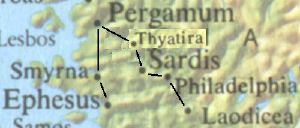 |
The first church, at Ephesus, is promised, "To him that overcometh will I give to eat of the tree of life, which is in the midst of the paradise of God" (Rev. 2:7). Partaking of the fruit of the tree of life is always associated with the celestial kingdom and eternal life, as in Lehi's dream (1 Nephi 8:11; Alma 32:41-42). Thus, it is proposed that this reward is an allusion to the angel who presides over the congregation of celestial kingdom candidates. We have identified Uriel, the first angel, as the one assigned to that position. So far the order is perfect, because the first reward clearly corresponds to the first angel, Uriel (Peter).
The second church, at Smyrna, is promised that "he that overcometh shall not be hurt of the second death" (Rev. 2:11). In modern revelation we are told that the only ones over whom the second death will have power are the sons of perdition (D&C 76:32, 36-37). That seems like an unusual promise to give, that they will not become sons of perdition. This is a big clue that we do not have here merely a list of seven restatements of receiving the celestial kingdom, but that more is hidden in these sayings. The hope of not becoming a son of perdition, that is, of receiving the telestial kingdom, would refer to the congregation we have identified as being led by the third holy angel, Sariel (Abel). Now the order is not as obvious, because the second reward corresponds to the third angel, so let us postpone searching for an ordered pattern until all the rewards are matched to angels.
The third church, at Pergamos, is told that "To him that overcometh will I give to eat of the hidden manna, and will give him a white stone, and in the stone a new name written, which no man knoweth saving he that receiveth it" (Rev. 2:17). The white stone is associated with being a seer (seer stone) and Joseph Smith was the one of the seven most identified as a seer (2 Nephi 3:6). The seer and stone could also be associated with Peter and the celestial kingdom (D&C 130:11), but Peter fits the first reward best. Thus, this saying seems like an excellent way to identify the fifth angel, Phanuel (Joseph Smith).
The fourth church, at Thyatira, is promised that, "he that overcometh, and keepeth my works unto the end, to him will I give power over the nations" (Rev. 2:26). That is almost exactly what is said of Michael in the Book of Enoch:
"Michael, one of the holy angels, who presiding over human virtue, commands the nations." -- Enoch 20:5.The Book of Enoch was accepted as scripture at the time Revelation was given (Jude 1:14) so this saying would easily identify Michael to those familiar with it. Thus, this saying identifies the seventh angel, Michael (Adam).
The fifth church, at Sardis, is told that "he that overcometh, the same shall be clothed in white raiment and I will not blot out his name from the book of life" (Rev. 3:5). Being dressed in white implies the first resurrection (of the righteous), whereas having ones name in the book of life only guarantees that one is not a son of perdition (Rev. 20:15). Thus, together they indicate the terrestrial kingdom, which we have deduced is led by the second angel, Raguel (Moses).
The sixth church, at Philadelphia, is told, "Him that overcometh will I make a pillar in the temple of my God, and he shall go no more out: and I will write upon him the name of my God, and the name of the city of my God, which is the New Jerusalem, which cometh down out of heaven from my God: and I will write upon him my new name" (Rev. 3:12). The city that comes down from heaven is the City of Enoch, so Enoch is the natural correlation here (Moses 7:62-64). Notice that for this saying, it was convenient that Enoch has another role besides being the group leader for the sons of perdition, because it would have been hard to associate any reward at all with them. Thus, this reward is associated with the fourth angel, Raphael (Enoch).
The seventh church, at Laodicea, is promised, "To him that overcometh will I grant to sit with me in my throne" (Rev. 3:21). This saying is less obvious, but the Book of Enoch associates Gabriel with the cherubim (Enoch 20:7) and John saw that the four cherubim surround the throne of God (Rev. 4:6-8, compare Ezek. 10:14-20; 2 Kings 19:15; Psalms 80:1, 99:1; Isa. 37:16). Thus the last reward can be identified with the sixth angel, Gabriel (Noah).
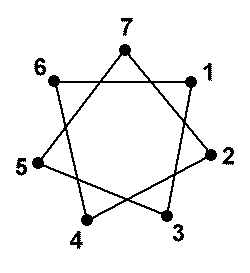 |
The fact that all seven of the rewards fit so well both with identifying one of the seven angels as well as just happening to come out in a clear order, is a strong witness that this is a correct interpretation. The Lord has promised always to give us a pattern by which we may know the truth, so that we will not be deceived (D&C 52:14), and the pattern of these seven rewards seems compelling.
Table 1 summarizes what has been deduced about the seven dispensations, angel names, their identities, as well as the associated rewards.
| 1,000 yrs | Name | Meaning | Mortal | Trump | Reward |
|---|---|---|---|---|---|
| First | Uriel | Light of God | Peter | Celestial | Tree of life |
| Second | Raguel | Friend of God | Moses | Terrestial | Clothed in White |
| Third | Sariel | Prince of God | Abel | Telestial | Conquer Second Death |
| Fourth | Raphael | Healer of God | Enoch | Perdition | New Jerusalem |
| Fifth | Phanuel | Face of God | Joseph Smith | Gospel | White Stone |
| Sixth | Gabriel | Man of God | Noah | Restoration | Sit on Throne |
| Seventh | Michael | Like Unto God | Adam | Triumph | Rule Nations |
In summary, the symbolism of the Feast of Trumpets and of the seven angels who sound their trumps at that time is rich indeed. The significance of the feast is principally to herald the coming judgments, and to call upon all to repent and be reconciled to God. Truly the Lord has given us much to ponder in the scriptures and in the many patterns provided. If we can "overcome," we have been promised the wonderful rewards described, including eternal life with our Father in Heaven.
Click the following link for a summary of the Millenial Feast of Trumpets.