by John P. Pratt
3 Feb 1999
(updated 22 Nov 2015)
©2015 by John P. Pratt. All rights Reserved.
The 260-day Sacred Round (also called the tzolkin) is the heart of the Aztec Calendar, the Mayan calendar and nearly every native calendar of the Americas. The sacred round is composed of two cycles, one of 20 named days, and one of 13 numbered days, each of which continuously repeats. It takes 260 days for the two cycles to realign on the beginning day of each cycle (260 = 20 x13), so the Sacred Round has 260 days.
The details are described below, but it should be noted at the outset that to this author, the Sacred Round is important enough that it could be used by even modern people, rather than being only be a curious artifact of an ancient culture.
|
|
 |  |
| 1. Light | |
|---|---|
 |  |
| 2. Wind | |
 |  |
| 3. Temple | |
 |  |
| 4. Dragon | |
 |  |
| 5. Serpent | |
 |  |
| 6. Skull | |
 |  |
| 7. Deer | |
 |  |
| 8. Rabbit | |
 |  |
| 9. Water | |
 |  |
| 10. Dog | |
 |  |
| 11. Monkey | |
 |  |
| 12. Grass | |
 |  |
| 13. Reed | |
 |  |
| 14. Jaguar | |
 |  |
| 15. Eagle | |
 |  |
| 16. Condor | |
 |  |
| 17. Quake | |
 |  |
| 18. Flint | |
 |  |
| 19. Storm | |
 |  |
| 20. Flower | |
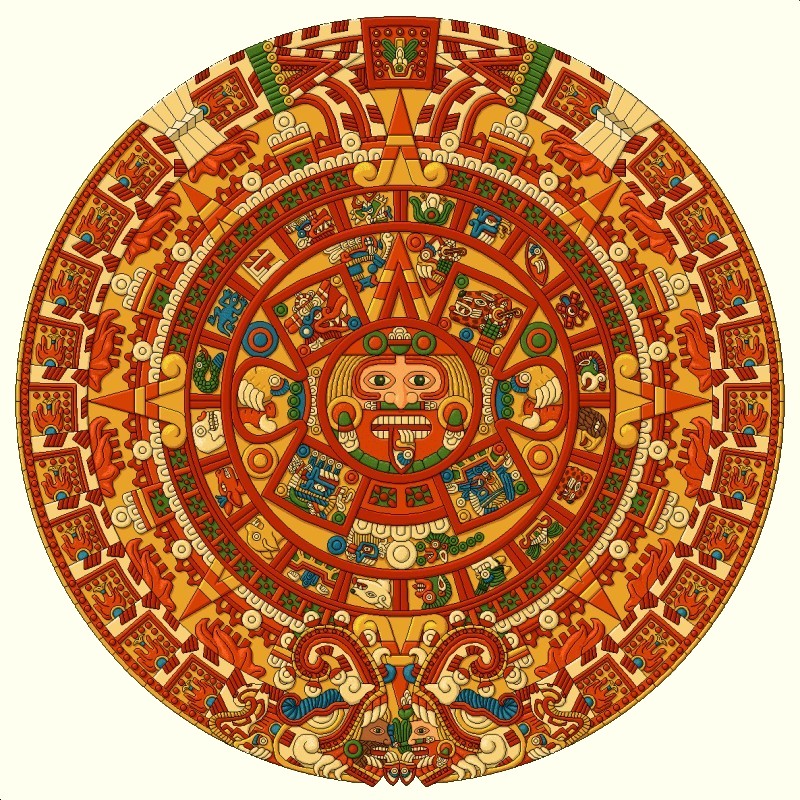
Each of the days is named and has an associated picture or glyph. The 20 day glyphs are shown in a circle in the famous Aztec Calendar Stone. This illustration is only of the central part of that calendar. The 20-day cycle begins at the top and goes around counter-clockwise.
The names were chosen by this author as the best English words to describe the idea. Most tribes had slight variations of the pictures and of what the name should be. For example, the first figure was either a crocodile, a water lily, or the sun. In every case, according to the Mayan priests, the original idea was that of the conception of new life. The crocodile and water lily, both floating in the water, fit the image of a fetus in the womb. The Olmec figure of the sun may represent the moment when the spark of life begins. I chose the word "Light" to best summarize this idea, and have proposed the figure of a sunrise to symbolize the first flash of dawn as representing that spark. A comparison of the Mixtec glyphs (from the Codex Nuttall) and my proposed modern icons are shown at left. The Mixtec figures are only slightly different from the Aztec.
The days were said by the Mayans to represent the steps in a person's life (from before birth to after resurrection). Thus, after the first day (Light) which represents conception, the second (Wind) is quickening, when the spirit enters the baby still in the womb, and the third (Temple) is the day of birth. The fourth (Dragon) is the day when evil is first allowed into the child's life, and the fifth (Serpent) represents repenting of evil ways and returning to the good life. The serpent represents this when it sheds it old skin and begins life anew. The sixth (Skull) represents death, and the seventh (Deer) represents the fleeting journey into the spirit world. The final thirteen steps are less clear, as is our understanding of life after death. The names and symbolism are explained in more detail on a separate page.
Note that the circular arrangement is important because there are several pairs of opposites. For example, the fifth day in the cycle is "Serpent," and directly opposite the serpent is the "Eagle." The eagle/serpent pair was so important to the Aztecs that their capital (now Mexico City) was founded where they saw the eagle with the serpent in its talons (now immortalized on the Mexican flag.)
The veintena is also the fundamental cycle of the Mayan Long Count, which is not discussed here. Moreover, Native American astrology, which assigns similar traits to people, is based on the day of the veintena on which they are born. This is described in a book entitled The Cherokee Sacred Calendar, by Raven Hail.
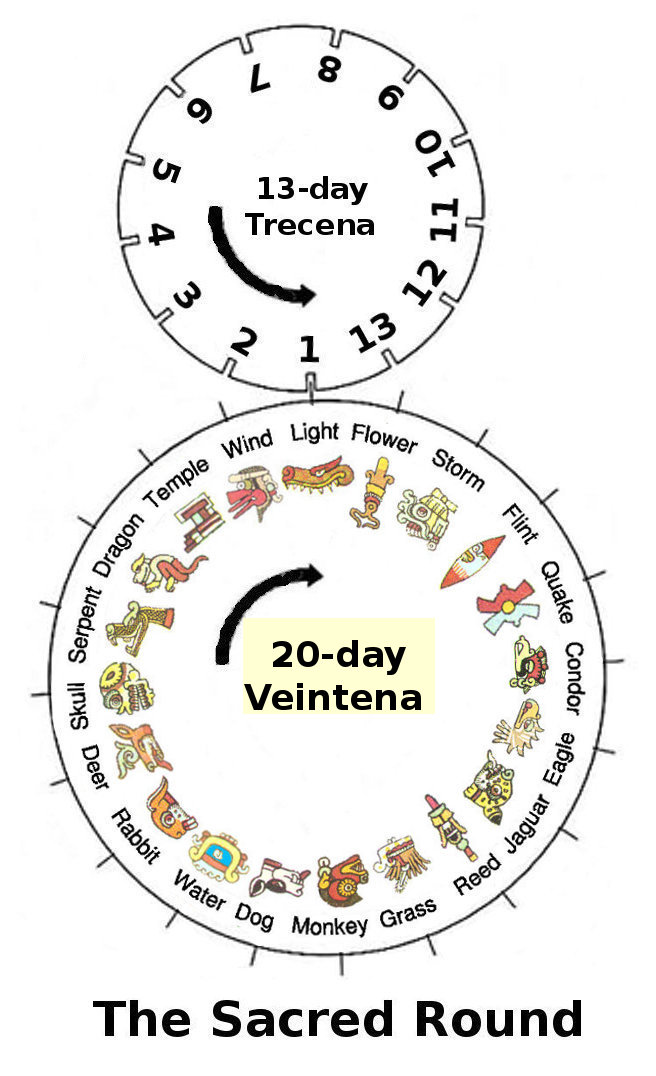 |
The two cycles each separately move through one day at a time, so the effect is similar to two gears, one with 13 cogs and the other with 20, as shown in the illustration. Thus, the Sacred Round begins at the position shown on the day 1 Light. The next day is 2 Wind and then 3 Temple. That may sound confusing if were expecting 1 Light to be followed by 2 Light and then 3 Light. But we do the same thing on our modern Gregorian calendar. The day after Monday the 1st (of a month) is Tuesday the 2nd. That is because the week of seven days progresses daily even as do the days of the month. The thirteenth day of the cycle is 13 Reed. The following day is 1 Jaguar, because the trecena starts over, but the veintena continues on through all 20 figures. It takes 260 days to get back to the starting position (13 x 20 = 260), so the Sacred Round contains 260 days.
One can ask whether the Sacred Round consists of 13 cycles of 20 days or 20 cycles of 13 days. Most Native Americans think of the Sacred Round as 20 trecenas. There are two conventions for naming the twenty trecenas. The Aztecs named them for the first day, that is, for when the day number was 1. Thus the first trecena was called "1 Light" after the first day. The second trecena was "1 Jaguar". (See Aztec ordering Table using both written names and modern icons.) Thus the first trecena is named 1 Light, for its first day. The second is 1 Jaguar. A Native American example of the thirteenth trecena "1 Quake" is illustrated in a wikipedia article).
My research has shown that the original naming of the trecenas would more likely have been to name each after the "zeroth" day. What is the zeroth day when the first is called "1"? It is the previous day, numbered 13. We do the same thing on our clocks which number hours from 1 to 12. The zero point (midnight or noon) on a clock is the number 12. The day preceding the first day 1 Light is 13 Flower. Therefore, using this system, the name of the first trecena is "Flower". This version of the perpetual calendar is illustrated both with written names and modern icons.) Does that look strange to have the 13 first in the table? Which came first yesterday: an event that happened at 11:30 a.m. or one that happened at 12:30 a.m.? That's right, the 12:30 event was first, happening just after midnight, and the 11:30 was nearly half a day later, happening just before noon. So if we laid out a table of hours of the day, the "Hour 12" column would be first and the "Hour 1" would be second.
In passing, we can note that almost every author illustrates this entire table backwards and shows the Sacred Round as 13 veintenas rather than 20 trecenas. The reason they do so is that it is much easier to make a table of 260 numbers rather than 260 words or pictures. But it is important to get it right if one actually wants to use it.
The correlation of the Sacred Round to our calendar used in my work differs by one day from the usually accepted GMT correlation. For example, most researchers would say the day 13 Oct 1950 was 13 Serpent, but in my work it is called the next day, 1 Skull. It is interesting that "GMT" stands for the initials of three different researchers none of whom would have said that date was 13 Serpent, and none of whom would have agreed with each other, but all were within five days of each other. The GMT correlation uses one of the other two days within that set of five. My work has shown all four of those five are wrong! I use the last of the five, different from GMT and all of theirs!
Also in my work it has become clear that some days are "holy days" and some are "most holy". Any day with a day number of 1, 7, or 13 is a holy day. They are the first, middle and last days of a trecena. If the day number is 1 or 13 and the name is Light, Wind, Temple, Serpent, Reed, Eagle or Flower, then the day is most holy. Note that this follows a common pattern that there are 7 days which are most holy. In my work holy days are often shown in blue and most holy days in red, whereas normal days are in black.
There is another unit of time associated with the Sacred Round called the "Step". It is exactly 40 days long. That unit is built into the system because forty days after any day on the Sacred Round increments the number by one. For example 40 days after 4 Jaguar is 5 Jaguar. That is because 40 divided by 20 goes evenly, so the glyph stays the same, but 40 divided by 13 has a remainder of 1, so the day in incremented by one.
Most of the times that an interval of "forty days" is mentioned in the Bible, either or both of the beginning and end days are holy. For example, the Savior resurrected on the most holy day 13 Temple and after his 40-day ministry the Ascension occurred on step later on the most holy day 1 Temple.
Sometimes the interval is counted inclusively where the first day is counted as day one. For example, the law of Moses commands that a male child be presented to the priest at the temple on the fortieth day of life, counting the birth as the first day (Lev. 12:2-6). In that case, the interval is really only 39 days later. Jesus was born on the day 1 Reed. He was taken to the temple on the day 1 Grass, 39 days later. The next day was 2 Reed. Note that both 1 Reed and 1 Grass are holy days, whereas 2 Reed is not.
Although most Bible commentators assume that the forty day interval is only approximate, in my work it is shown that in every case it means exactly 39 or 40 days, depending on whether it is to be counted inclusively.